Court Pace Variations and Serve Performance Metrics in Global Professional Tennis Competitions
Written by Jakob Lorenz · Aug 13, 2026
Court Pace Variations and Serve Performance Metrics in Global Professional Tennis Competitions
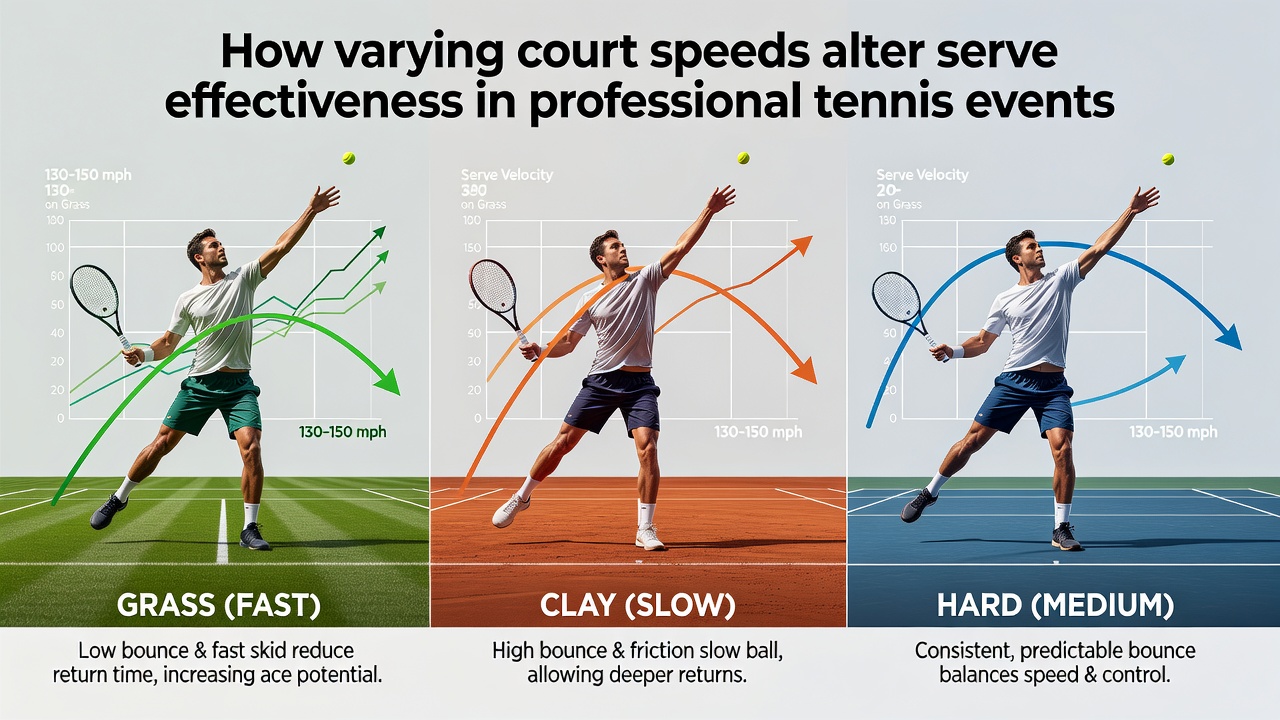
Professional tennis surfaces produce measurable differences in ball speed and bounce height that directly affect serve outcomes, and data from ATP and WTA events illustrate these patterns across grass, clay, and hard courts. Court pace ratings established by the International Tennis Federation range from 1 for the slowest surfaces to 5 for the fastest, while serve statistics collected at events like Wimbledon and the French Open show consistent correlations between these ratings and metrics such as ace percentage plus first-serve win rate. Observers note that players adjust spin rates and placement strategies when transitioning between surfaces because faster courts reduce reaction time for returners and allow flatter serves to skid through the court.
Measuring Court Speed and Its Direct Effects on Serve Trajectories
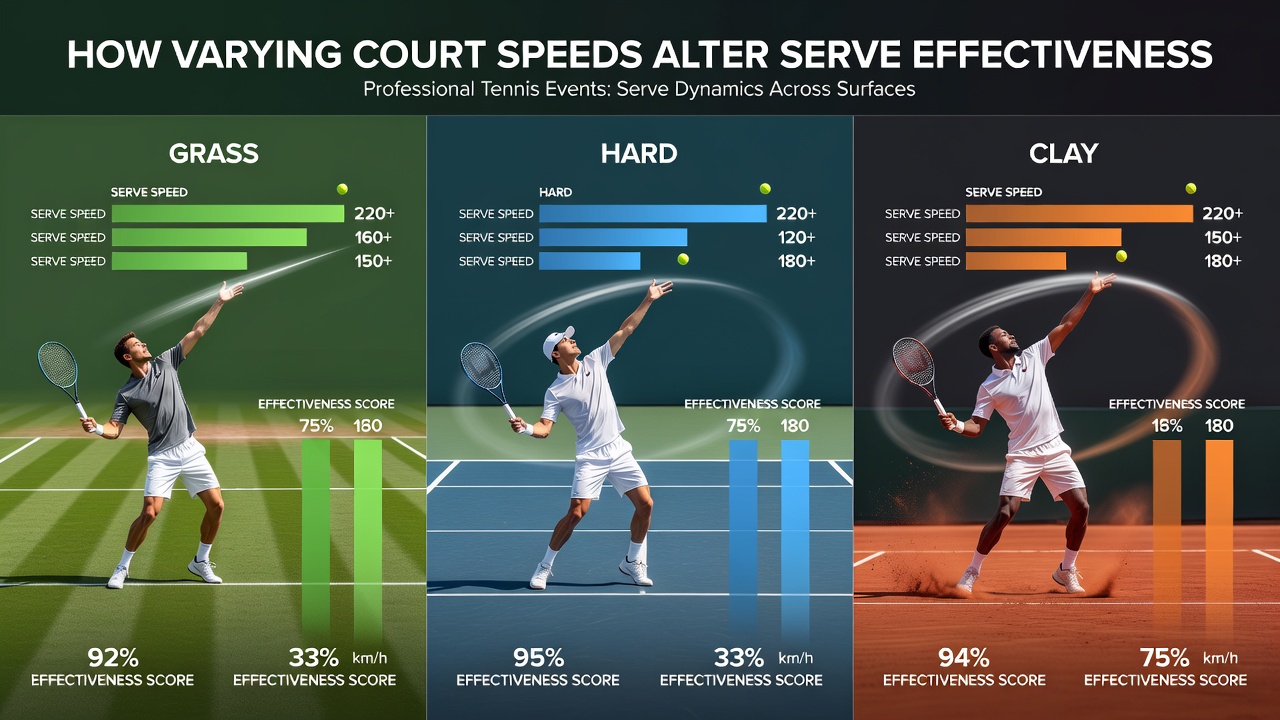
Researchers at tennis governing bodies record court pace through standardized tests that measure how far a ball rebounds after impact at controlled speeds, and these figures reveal why serve effectiveness rises on surfaces rated above 4 while declining on those rated below 2. Grass courts typically register pace ratings between 4.5 and 5.0 during the summer swing, whereas clay surfaces fall between 1.0 and 2.0, creating longer rallies that favor players who construct points rather than relying on outright serve winners. Hard courts sit in the middle range of 3.0 to 4.0 at most North American and Asian events, which produces a balance where big servers still record high ace totals but returners maintain higher break percentages than on grass. Data from the 2025 season indicate that average ace rates on grass reached 12.4 percent for men compared with 6.8 percent on clay, while first-serve win percentages followed a similar gradient of 78 percent on grass versus 68 percent on clay.
Player Adaptations Across Surface Transitions
Elite competitors modify racket head speed and spin production when moving from one surface to another, and video analysis from multiple Grand Slams demonstrates that top servers increase slice and kick serves on slower courts to compensate for reduced pace. Players who excel on fast surfaces often generate lower spin rates around 2,200 revolutions per minute on grass serves, whereas the same athletes raise spin to 3,000 revolutions per minute on clay to create higher bounce that disrupts return timing. Those who studied match data from the Australian Open and Roland Garros found that second-serve win rates drop by an average of 9 percentage points when players shift from medium-paced hard courts to slow clay, because returners gain extra time to handle kick serves that would otherwise push them wide. And yet the same analysis shows that flat first serves maintain higher effectiveness on indoor hard courts where humidity and temperature remain controlled, allowing the ball to retain speed through the air.
Statistical Patterns from Recent Tours
ATP and WTA tracking systems log every serve during main-draw matches, and aggregated figures from 2024 through early 2026 demonstrate that surface speed accounts for roughly 35 percent of variance in ace production after controlling for player ranking and weather conditions. Events held in August 2026 at the US Open hard courts produced ace rates 2.1 percentage points higher than the same players achieved on European clay earlier that season, while break-point conversion rates moved in the opposite direction. Tournament organizers in North America and Australia publish these metrics publicly, and analysts at organizations such as ATP Tour statistics confirm that servers ranked in the top 20 achieve 82 percent first-serve win rates on grass but only 71 percent on clay across comparable sample sizes. The pattern holds for both men and women, although WTA events display smaller absolute differences because average serve speeds sit 10 to 15 kilometers per hour below ATP levels.
Equipment and Rule Factors That Interact with Surface Speed
Racket string tension and ball compression standards set by the International Tennis Federation interact with court pace to further modulate serve outcomes, while lower tensions around 18 kilograms allow greater string bed deflection that increases spin on slower surfaces. Manufacturers test balls for diameter and rebound height under controlled conditions, and officials enforce these specifications at every professional event to maintain consistency within each surface category. Data collected during the 2026 North American swing showed that balls meeting the higher-compression standard produced serve speeds 4 kilometers per hour faster on medium-paced hard courts than the softer balls used at some European clay tournaments, directly elevating ace totals for players who rely on raw power rather than placement. Those who reviewed equipment logs from multiple regions note that indoor venues in Canada and Scandinavia often combine faster effective pace with lower air density, which further amplifies serve dominance during winter hard-court events.
Conclusion
Comprehensive tracking across professional tours establishes that court speed ratings correlate strongly with serve win percentages, ace frequency, and break-point outcomes, while player adaptations in spin and placement mitigate but do not eliminate these effects. Surface transitions during the annual calendar require athletes to recalibrate tactics within days, and governing bodies maintain detailed records that allow ongoing analysis of performance trends. Continued data collection from events scheduled through late 2026 will refine understanding of how incremental changes in pace ratings influence overall match dynamics at the highest levels of the sport.