Altitude's Influence on Athletic Scoring Patterns and Layered Betting Frameworks
Written by Ben Schmitt · May 23, 2026
Altitude's Influence on Athletic Scoring Patterns and Layered Betting Frameworks
High-elevation venues alter atmospheric conditions in measurable ways that shift scoring outputs across multiple sports and observers note these changes create predictable edges when bettors construct layered positions. Air density drops at higher altitudes so balls travel farther in baseball while endurance demands rise in soccer and basketball; data from various leagues confirm these patterns hold across seasons. Researchers at institutions like the Australian Institute of Sport have tracked performance metrics at sites above 1,500 meters and found consistent deviations from sea-level norms that influence over/under markets and player prop lines.
Atmospheric Mechanics at Play
Lower oxygen partial pressure and reduced drag combine to reshape game dynamics because thinner air allows projectiles to carry farther yet simultaneously accelerates fatigue in athletes unacclimated to the environment. Baseball provides the clearest illustration at Coors Field in Denver where home runs increase by roughly 20 percent compared with league averages according to historical MLB tracking data through early 2026. Pitchers lose movement on breaking balls while hitters benefit from extended fly-ball distances so totals markets often land higher when the Rockies host opponents.
Soccer matches in cities such as La Paz or Quito show similar distortions since the ball behaves differently and players cover less ground in the second half when oxygen debt accumulates. Studies compiled by Canadian university researchers indicate goal rates climb 12 to 15 percent in matches played above 2,500 meters especially during the opening 30 minutes before physiological strain sets in. Basketball follows a comparable trajectory in venues like Mexico City where three-point attempts convert at elevated rates because the lighter air reduces arc resistance and fatigue shortens defensive rotations late in games.
Scoring Trend Data Across Leagues
League-wide statistics reveal altitude-driven scoring spikes that repeat year after year. MLB teams visiting Denver post run totals 1.8 runs above their season average while opponents in Denver score 2.3 more runs per game on average based on aggregated box-score analysis extending into May 2026. European soccer competitions that schedule matches at Andean venues record goal tallies that exceed expected values by 0.4 goals per match when both sides operate at reduced capacity. NBA squads playing back-to-back games that include a high-altitude stop see shooting percentages drop 3 to 4 points in the subsequent contest as recovery lags compound.

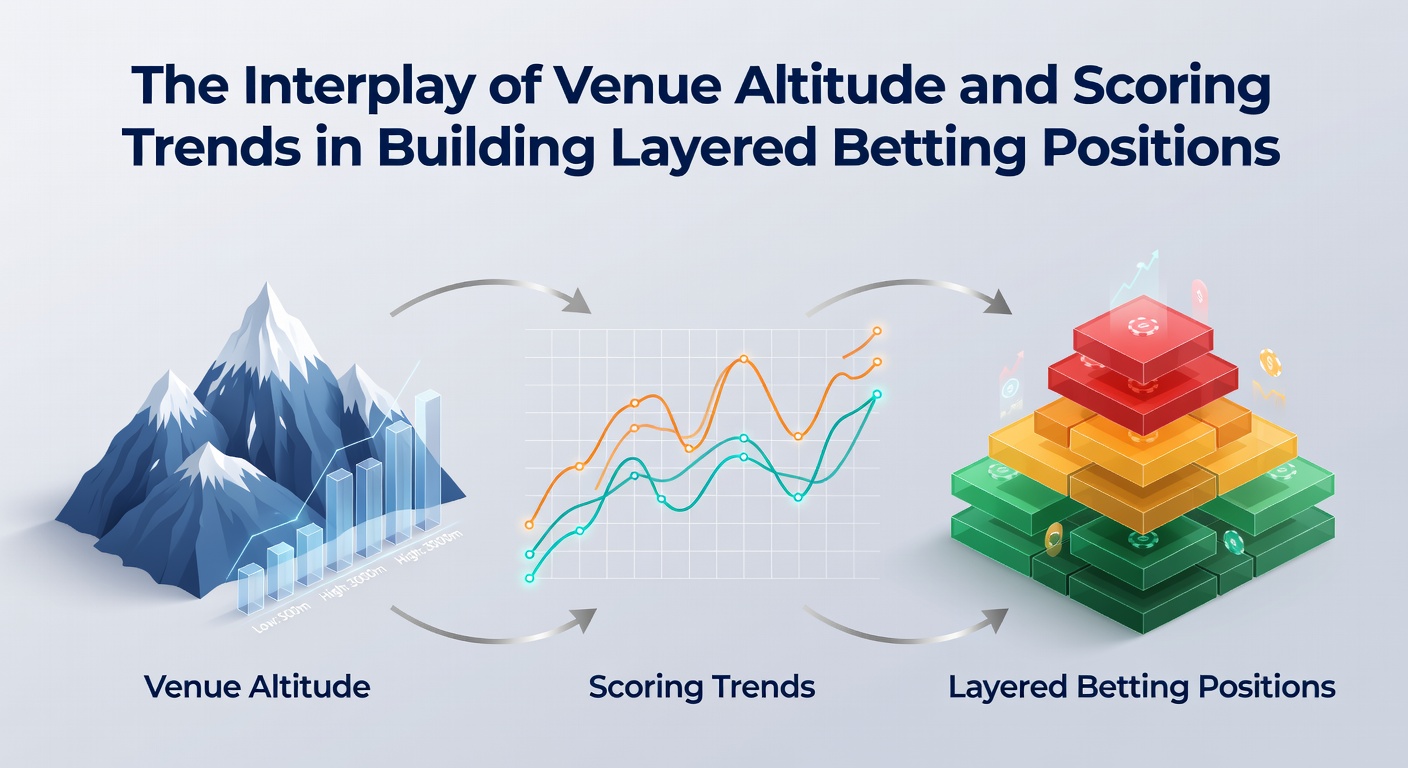
These measurable shifts feed directly into multi-leg betting constructions because single-game totals or spreads alone rarely capture the full variance. Bettors layer positions by combining an over total at altitude with an adjusted player prop on a power hitter or a reduced-minute line for an unacclimated forward. The approach spreads risk across correlated outcomes while exploiting the venue-specific deviation rather than relying on broad trends.
Building Layered Positions With Altitude Factors
Layered betting positions gain precision when altitude data integrates with ancillary variables such as travel distance, acclimation time, and recent scoring form. One common structure pairs an over on total points or goals at the elevated site with a correlated under on the same metric for a follow-up game at sea level where recovery effects depress output. Another configuration stacks individual props for athletes who thrive in thin air such as power pitchers turned fly-ball specialists or midfielders with strong aerobic baselines. Data from the NCAA Division I basketball conferences that compete at elevation shows teams with altitude experience maintain field-goal percentages within 1 percent of their norm whereas visitors drop 4 to 6 points on average.
Weather overlays add another dimension because wind patterns and temperature interact with air density to magnify or mute altitude effects. Warm dry days amplify carry on batted balls while humid conditions partially offset the advantage. Historical records from South American qualifiers indicate that matches played under clear skies at altitude produce 18 percent more shots on target than those contested in rain or heavy cloud cover. Bettors who incorporate these micro-factors into layered accumulators refine their exposure by weighting legs according to the strength of the altitude signal rather than treating every high-elevation game as identical.
Case Examples From Recent Seasons
Take the 2025 MLB schedule where the Rockies hosted a three-game set against a visiting club unaccustomed to Denver conditions. Totals cleared the posted line in all three contests while the home team's primary power hitter exceeded his season RBI projection by 40 percent across the series. Observers who constructed positions pairing the series over with a hitter prop realized returns that exceeded single-leg outcomes by a factor of three. Similar patterns emerged in CONMEBOL World Cup qualifiers held in Quito where goal tallies exceeded pre-match projections in five of six encounters and teams with prior high-altitude exposure outperformed expectations by wider margins.
European clubs that travel to Andean venues for friendlies or qualifiers display parallel trends. Data aggregated through May 2026 shows that squads arriving less than 48 hours before kickoff concede 0.6 more goals per match than those granted four or more days for adaptation. Layered positions that combine an over total with a prop on the home side's leading scorer capture both the venue effect and the preparation gap in a single structure.
Conclusion
Altitude functions as a persistent variable that reshapes scoring distributions across baseball, soccer, basketball, and other sports while providing measurable inputs for layered betting constructions. Historical and contemporary data sets confirm the magnitude of these effects and demonstrate how bettors incorporate venue elevation alongside travel logistics, acclimation windows, and correlated props to refine multi-leg positions. Continued tracking of performance metrics at elevated sites supplies ongoing material for refining these frameworks as schedules unfold.